




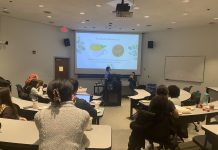




















Monday night, the College’s Students for Informed Democracy hosted speaker Thelma Young, campaign coordinator for the United States Campaign for Burma.
Burma is in a “dire state,” Young said. There are about 1 million displaced people, 70,000 child soldiers and 3,500 villages that have been destroyed by Burma’s military junta last year.
“There are more child soldiers in Burma than in any other country in the world,” Young said. In eastern Burma, ethnic cleansing has forced villagers to leave the country as refugees.
“Whatever ethnicity you are, you’re oppressed,” Young said.
Three years ago, Young worked on the Thailand-Burma border and spent much of her time working with the Burmese Women’s Union and interviewing women workers in Thai factories.
“The women were forced to work as illegal immigrants in Thailand,” she said. “The fact that they would rather work in a factory than be in Burma was a really big sign to me.”
As campaign coordinator, Young currently works with international grassroots movements that support the end of the military dictatorship in Burma.
“We do a lot of political advocacy work,” Young said. “Essentially anything to do with congress in Burma.”
Due to Chinese support of the Burmese dictatorship, the U.S. Campaign for Burma is currently collecting signatures of people pledging not to watch the 2008 Beijing Olympics.
“China is the biggest supplier of weapons to the Burmese army,” she said. The opening day of the Olympics, Aug. 8, is also the 20-year anniversary of the biggest uprising in Burma’s history, which, Young commented, “is like a slap in the face.”
Young said the military dictatorship remains in power even though representatives of the National League for Democracy Party, led by Nobel Peace Prize winner Aung San Suu Kyi, won the general election with 82 percent of the vote in 1990.
She said most protests to the situation in Burma, including those in the late 1980s and the more recent Saffron uprising in 2007, have been peaceful.
“The democracy groups are all about non-violence,” Young said.
Young concluded that there is hope in the movement for democracy in Burma.
“I think this can be one of the biggest causes of our generation,” Young said. “It’s a situation that is almost completely black and white.”


